
Squat Depth Explained: How Low Should You Actually Go?
7 min read
“Go lower” is the most common squat cue and the least specific. Depth has a strict meaning on a powerlifting platform, a looser one in the gym and a measurable one on video — and they aren't the same thing. Here's what each means, what the research says about squatting deep, what usually stops you, a five-minute self-test to find your depth, and how to check it on video.
Three ways to define depth
- The powerlifting standard. Seen from the side, the crease of your hip drops below the top of your knee. It's the rule judges use, and the strictest of the three.
- Thighs parallel. The top of your thigh is level with the floor. This is what most people in the gym mean by “parallel”.
- Knee angle. The angle at your knee between thigh and shin — about 180° standing, smaller the deeper you go. It's what a camera can measure, and it's what FormLens uses.
They don't line up exactly. Your shins lean forward as you squat, so seen from the side your thighs usually reach horizontal a little after your knee angle passes 90°. A 90° knee angle is a useful minimum, not a competition-legal squat. Limb lengths, stance and ankle mobility shift the relationship further, which is why a knee angle works best as a yardstick for your own squats over time.
Side-on
The knee angle is the angle between thigh and shin.
Front-on
The same depth: the thigh points at the camera, so the angle reads larger.
Is deeper better?
Mostly, yes — if you own the position. In a 10-week study, 17 men squatted either to full depth, knees bent about 140° from straight, or to a half squat, knees bent 90° — the same point as FormLens's 90° line. Quadriceps growth was about the same, 4.9% versus 4.6%, but the full-squat group grew more glute and adductor muscle and gained more full-squat strength (Kubo 2019 (opens in a new tab)).
Going much shallower does cost you: in a 12-week study, deep squats (knees bent 120°) built more front-thigh (quadriceps) muscle than quarter squats (knees bent 60°) (Bloomquist 2013 (opens in a new tab)). So past about parallel, extra depth isn't a shortcut to bigger quads, but it does train more of your hips — and you get strongest in the range you train.
The old worry that deep squats wreck knees isn't well supported either. A 2013 review concluded that, with sound technique and gradually increasing loads, deep squats don't raise the injury risk to the knee's passive tissues compared with partial squats (Hartmann 2013 (opens in a new tab)).
The catch is control. Depth only counts if your heels stay down, your brace holds and your pelvis doesn't tuck hard under the bar. The best depth is the deepest position you can reach — and leave — with the same form, rep after rep.
What limits your depth
- Ankle mobility. If your knees can't travel forward over your toes, your heels lift or your torso folds forward to keep you balanced — see heels lifting in the squat.
- Hip anatomy. The depth and angle of the hip sockets differ from person to person. Some people simply squat deeper with a wider stance and more toe-out.
- Limb proportions. Long thighs relative to your torso mean more forward lean at the same depth. That's structure, not a fault.
- Bracing and control. Plenty of lifters reach depth unloaded but not under a bar — a skill and strength gap, not a mobility one.
- Load. When the weight is more than you can control at the bottom, depth is the first thing to go.
Self-test: find your depth in five minutes
Film each step from the side at hip height — the best angle for judging depth by eye — and compare the clips.
- Bodyweight squat. Heels flat, sit as deep as you comfortably can. Note the point where your heels want to lift or your pelvis starts to tuck.
- Knee-to-wall test. Face a wall with your foot a few centimetres away and drive your knee forward to touch it without the heel lifting. Move the foot back until you can only just touch. A short distance, or a big difference between sides, points to your ankles.
- Heels raised. Repeat the bodyweight squat with 1–2 cm plates under your heels. If depth improves a lot, your ankles are the main limiter.
- Stance change. Go a little wider and turn your toes out 15–30°. If depth improves, your hips prefer that stance.
- Goblet squat. Hold a dumbbell at your chest. If you reach depth easily here but not with a barbell, the limiter is bracing and load, not mobility.
How to squat deeper
- Ankles: knee-to-wall rocks and calf stretches most days, and squats with your heels raised — lifting shoes or small plates — while your range improves.
- Stance: use the stance and toe angle from your self-test, and let your knees follow your toes.
- Control: tempo squats with a three-second descent, pause squats at your target depth, and box squats to a box set at that depth.
- Load: drop 10–20%, own the depth for a few weeks, then add weight back gradually.
About butt wink
A small tuck of the pelvis at the very bottom is normal. If it's large and grows as the weight goes up, you've gone past the depth you can control today — see Butt wink in the squat.
Checking your depth with FormLens
FormLens measures your lowest knee angle on every filmed rep and draws a “Parallel” line at 90° on its depth-per-rep chart. A rep counts as reaching depth when your knee angle drops below that line, and the set is flagged when most reps stop short. The same front-on clip gives you the difference between your left and right knee angles and catches an obvious heel lift — useful, because an uneven or heels-up squat is often a depth problem in disguise. If your knees drift inward as well, see how to fix knees caving in.
Front-on depth reads conservatively
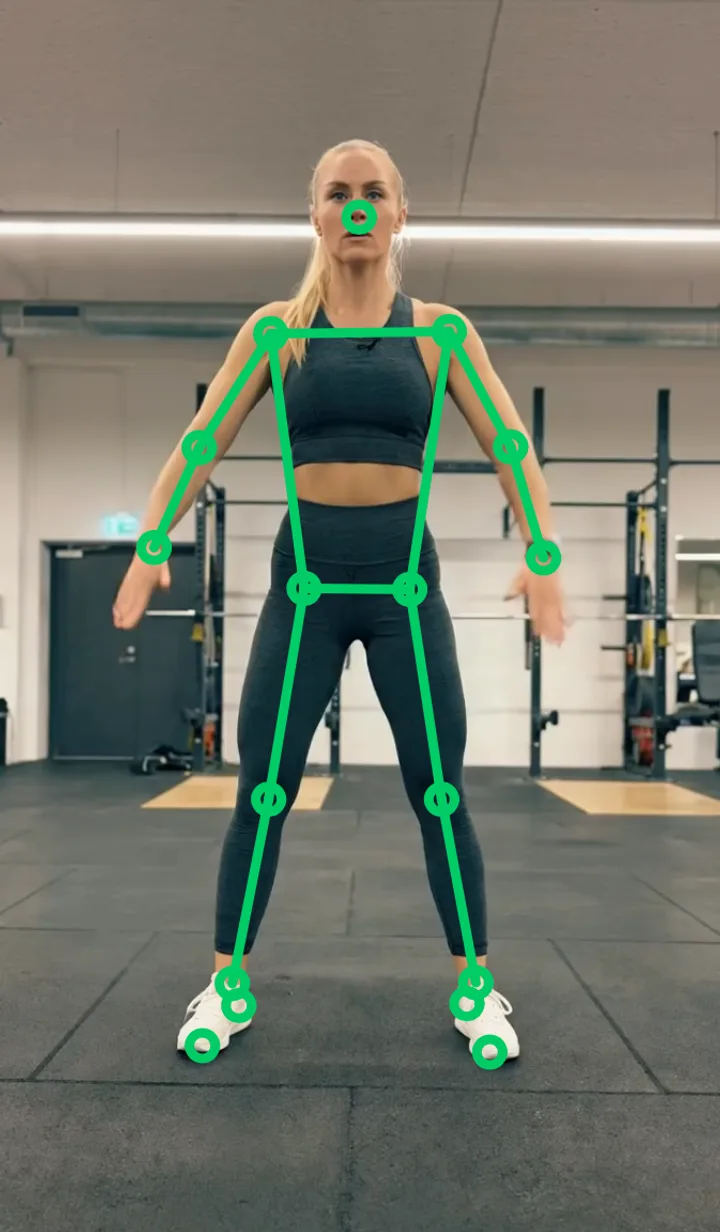
FormLens asks for squats filmed from the front, where stance, foot flare (toe-out) and left/right balance can be read. From the front the camera sees your thigh end-on, so the knee angle reads higher than it really is, and a squat at depth can be flagged as short. Treat the number as your trend line, filmed the same way each time; for a competition-standard check, add a side-on set and judge hip crease against knee yourself.
Setup matters as much as the lift — see how to film your lifts — and your depth is one of the measurements the AI coach reads for your form score.
Depth checklist
- Heels stay flat through the whole rep
- Brace set before you descend and held at the bottom
- Knees track in line with your toes
- Same depth on the last rep as on the first
- No hard pelvic tuck at the bottom
- Filmed from the same spot as last time
How FormLens measures this
Squat · Filmed front-on, phone at hip height
- Depth
- Your lowest knee angle on each rep. Under 90° counts as reaching depth; the set is flagged when most reps stop short.
- Left/right balance
- The difference between your left and right knee angles at the bottom. 10° or more flags a rep.
- Heel lift
- Checks the bottom of each rep for an obvious heel lift, read from one foot, and shows how many reps it caught. Small rises aren't flagged.
- Stance
- Stance width (as a multiple of your shoulder width) and foot flare (toe-out), read from your setup.
- Consistency and tempo
- How closely your reps match each other, and how steady your rhythm is, on multi-rep sets.
The “Parallel” line is a 90° knee angle — a consistent yardstick for your own squats, not the powerlifting hip-crease rule.
Not auto-flagged yet: knee cave, butt wink and back angle. Front-on, depth reads conservatively — the knee angle can read higher than it really is. Every measurement is an estimate from a single camera, so setup matters — see the camera setup.
FAQ
Is it bad to squat below parallel?
Not for most healthy lifters who can control it. A review of the research concluded that, with sensible technique and loading, deep squats don't raise the injury risk to the knee's passive tissues compared with partial squats (Hartmann 2013 (opens in a new tab)). If a position hurts, don't force it — see a physio.
Do deep squats build bigger quads?
Past about parallel, not much more: in Kubo 2019 (opens in a new tab), quadriceps growth was similar for full squats and for half squats with the knees bent 90°. Much shallower squats built less: quarter squats (knees bent 60°) grew less front-thigh muscle than deep ones (Bloomquist 2013 (opens in a new tab)). Full squats did build more glute and adductor muscle.
Why does FormLens say I missed depth when I think I hit it?
Two reasons. FormLens's line is a 90° knee angle, not the hip-crease rule. And squats are analysed front-on, where the knee angle reads higher than it really is. Compare against your own earlier sets filmed the same way, and use a side-on clip to judge the powerlifting standard.
Should I use lifting shoes or heel plates?
If your ankles limit your depth, a raised heel is a legitimate tool — many lifters squat in weightlifting shoes for good. Keep working on ankle mobility alongside it.
How deep should a beginner squat?
As deep as you can while your heels stay down and your back holds its position. A box set at that height makes it repeatable; lower the box as you improve.
Sources
- Kubo K, Ikebukuro T, Yata H. Effects of squat training with different depths on lower limb muscle volumes. Eur J Appl Physiol. 2019;119(9):1933–1942. View study (opens in a new tab)
- Bloomquist K, Langberg H, Karlsen S, Madsgaard S, Boesen M, Raastad T. Effect of range of motion in heavy load squatting on muscle and tendon adaptations. Eur J Appl Physiol. 2013;113(8):2133–2142. View study (opens in a new tab)
- Hartmann H, Wirth K, Klusemann M. Analysis of the load on the knee joint and vertebral column with changes in squatting depth and weight load. Sports Med. 2013;43(10):993–1008. View study (opens in a new tab)
Educational only — not medical advice. FormLens is a training aid, not a medical device; measurements are estimates from a single camera. If something hurts, see a physio or doctor. Terms of Use
First published · Last updated · By FormLens