
How to Fix Knees Caving In on Squats (Knee Valgus)
6 min read
If your knees drift inward as you stand up out of a squat — especially on heavy sets or the last few reps — you're seeing knee valgus, usually called knee cave. It's one of the most common things lifters spot when they first film themselves. Here's what it is, how much it matters, how to find your cause with a few quick tests, and the cues and drills that fix it.
What knee valgus is
Knee valgus is your knees moving inward, toward each other, instead of staying in line with your feet. It's rarely just the knee: usually the thigh turns in and moves inward at the hip, the arch of the foot flattens, or both. It tends to show up on the way up, out of the bottom, and to get worse as the weight climbs or as you tire.
A little isn't automatically a fault. Plenty of strong lifters show a brief inward drift out of the bottom on maximal attempts and push straight back out. The pattern worth fixing is a collapse you see on most reps, one that grows through the set, or one knee caving more than the other.
Does knee cave cause injuries?
Less clearly than the internet suggests. Knee valgus is best known as an ACL risk factor in jumping and landing sports, based largely on a 2005 study of female athletes (Hewett 2005 (opens in a new tab)). A much larger later study of 710 elite female soccer and handball players found that a drop-jump test measuring the same kind of knee motion predicted ACL injury poorly (Krosshaug 2016 (opens in a new tab)). Those are landings, not squats, and there's little direct evidence for barbell squats.
The practical case for fixing it is simpler. A consistent cave means you're not controlling the load in the position you set up in: force leaks sideways instead of into the floor, and the pattern usually gets worse exactly when sets get hard. If it comes with knee pain, stop guessing and see a physio.
Why it happens
- Hip control. Your glutes and hip rotators hold the thigh in line. When they can't keep up, the thigh turns in and the knee follows — a lot of what looks like a knee problem can start at the hip (Powers 2010 (opens in a new tab)).
- Ankle mobility. When your ankle can't bend far enough, your body finds the range elsewhere. In a lab study, restricting ankle bend during a squat increased knee valgus and inward knee movement (Macrum 2012 (opens in a new tab)).
- Foot position. A collapsing arch rotates the shin inward and drags the knee with it.
- Stance and toe angle. If your toes point out but you drive your knees straight forward, they'll look caved relative to your feet.
- Load and fatigue. A weight beyond what you can control, or the last reps of a hard set.
- Skill. For newer lifters it's often just a pattern that hasn't been learned yet.
Self-test: find your cause
Film each test from the front at hip height — the same angle FormLens uses for squats.
- Light versus heavy. Compare a warm-up set with a heavy set. Caving only when it's heavy, or late in the set, points to strength and fatigue. Caving at every weight points to a movement pattern or mobility.
- Knee-to-wall test. Foot a few centimetres from a wall, drive the knee forward to touch it without lifting the heel, and move back until you only just can. A short distance, or a big difference between sides, points to your ankles.
- Single-leg step-down. Stand on a low step and slowly lower the other heel to the floor. If the standing knee dives inward, hip control is a likely driver.
- Band test. Loop a mini-band just above your knees and squat. If you can easily keep your knees out against the band, the ability is there — it's a cue and awareness problem.
- Barefoot check. Squat barefoot and watch your arches. If they collapse as you descend, start with the feet.
How to fix it
Match the fix to the cause you found.
- Cues: “spread the floor” or “knees over toes”; a tripod foot, with big toe, little toe and heel all pressing down; a full brace before you descend, and a controlled way down.
- Hip strength: side-lying hip abduction, banded lateral walks and clamshells — two or three sets, a few times a week.
- Pattern practice: goblet squats and banded squats with a deliberate knees-out cue, tempo squats with a three-second descent, and pause squats at the bottom.
- Ankles: knee-to-wall rocks and calf stretches, plus squats with your heels slightly raised while your range improves.
- Load: drop 10–20% and build clean reps back up before adding weight.
Don't overcorrect. The goal is knees tracking in line with your toes, not shoved out as far as they'll go — that just rolls your weight onto the outside of your feet.
Checking it on video
Film from the front at hip height with your feet and hips in frame. FormLens doesn't auto-flag knee cave yet, so this is how to check it with the app today: open the analysis and replay the clip with the skeleton overlay on. Watch the knee points against the hip and ankle points at the bottom and on the way up. Do they stay stacked over your feet, and does one side move more than the other?
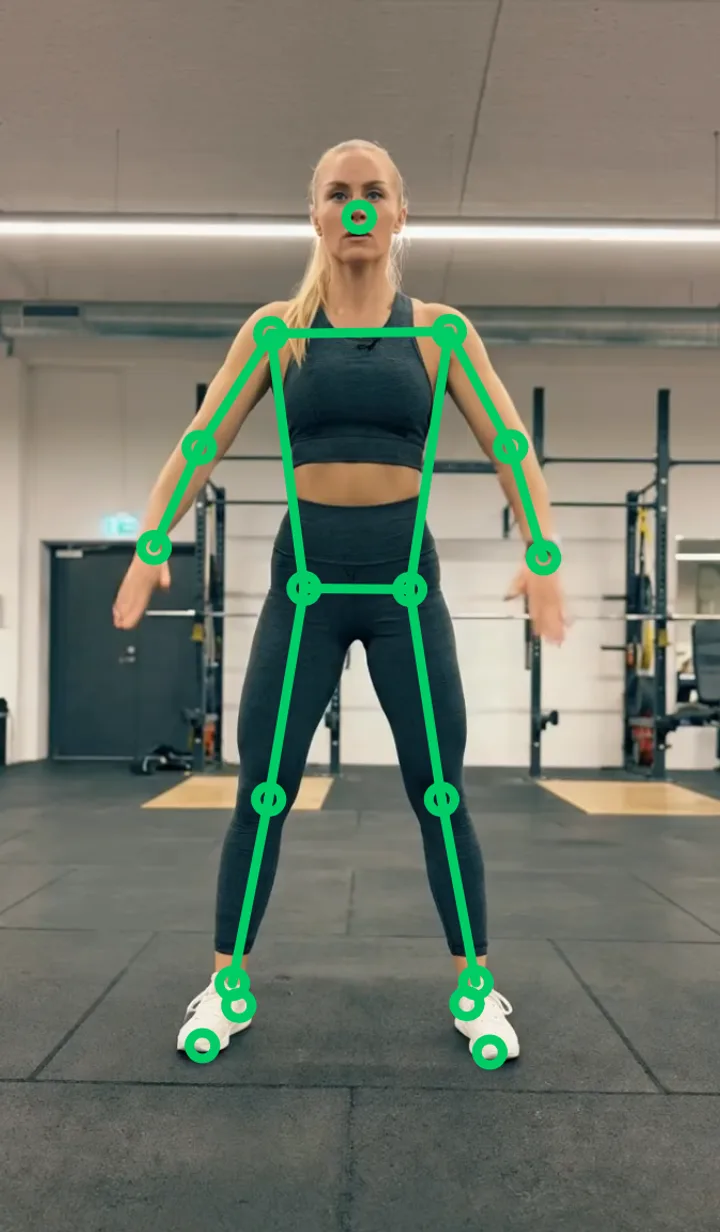
The same clip gives you what FormLens does measure for the squat: your depth on every filmed rep, the difference between your left and right knee angles (10° or more flags a rep) and an obvious heel lift. Knee cave often travels with a depth or heel problem, so read them together — see squat depth explained, heels lifting in the squat, and butt wink in the squat if your pelvis tucks at the bottom too. Film from the same spot every time (here's how) and re-film every week or two at the same weight to see whether the fix is holding — the depth and balance numbers also feed your form score.
Knee tracking checklist
- Tripod foot: big toe, little toe and heel down
- Toes turned out slightly, knees following the toes
- Brace set before the descent
- Knees stay over the feet on the way up, not just on the way down
- Both sides move the same
- A weight you can control for every rep
How FormLens measures this
Squat · Filmed front-on, phone at hip height
- Depth
- Your lowest knee angle on each rep. Under 90° counts as reaching depth; the set is flagged when most reps stop short.
- Left/right balance
- The difference between your left and right knee angles at the bottom. 10° or more flags a rep.
- Heel lift
- Checks the bottom of each rep for an obvious heel lift, read from one foot, and shows how many reps it caught. Small rises aren't flagged.
- Stance
- Stance width (as a multiple of your shoulder width) and foot flare (toe-out), read from your setup.
- Consistency and tempo
- How closely your reps match each other, and how steady your rhythm is, on multi-rep sets.
Checking knee cave: replay your front-on clip with the skeleton overlay and watch the knee points against your feet, at the bottom and on the way up.
Not auto-flagged yet: knee cave, butt wink and back angle. Front-on, depth reads conservatively — the knee angle can read higher than it really is. Every measurement is an estimate from a single camera, so setup matters — see the camera setup.
FAQ
Is some knee cave normal?
A brief inward drift on a maximal effort is common and not necessarily a problem. A consistent collapse on most reps, or one that gets worse through the set, is worth fixing.
Should I push my knees out as far as possible?
No. Aim for knees tracking in line with your toes. Forcing them far outside your feet rolls you onto the outer edges of your feet and costs you balance.
Will lifting shoes fix it?
If limited ankle mobility is your driver, a raised heel can reduce the compensation while you work on your ankles. It won't fix a hip-control problem.
Does FormLens detect knee valgus?
Not automatically yet. Replay your clip with the skeleton overlay to check it by eye. FormLens does measure squat depth, the left/right knee-angle difference and an obvious heel lift on every filmed rep.
When should I see a professional?
If your knee hurts during or after squatting, swells or feels unstable, see a physio or doctor. This guide is about technique, not injuries.
Sources
- Hewett TE, Myer GD, Ford KR, et al. Biomechanical measures of neuromuscular control and valgus loading of the knee predict anterior cruciate ligament injury risk in female athletes: a prospective study. Am J Sports Med. 2005;33(4):492–501. View study (opens in a new tab)
- Krosshaug T, Steffen K, Kristianslund E, et al. The vertical drop jump is a poor screening test for ACL injuries in female elite soccer and handball players: a prospective cohort study of 710 athletes. Am J Sports Med. 2016;44(4):874–883. View study (opens in a new tab)
- Powers CM. The influence of abnormal hip mechanics on knee injury: a biomechanical perspective. J Orthop Sports Phys Ther. 2010;40(2):42–51. View study (opens in a new tab)
- Macrum E, Bell DR, Boling M, Lewek M, Padua D. Effect of limiting ankle-dorsiflexion range of motion on lower extremity kinematics and muscle-activation patterns during a squat. J Sport Rehabil. 2012;21(2):144–150. View study (opens in a new tab)
Educational only — not medical advice. FormLens is a training aid, not a medical device; measurements are estimates from a single camera. If something hurts, see a physio or doctor. Terms of Use
First published · Last updated · By FormLens